
Most hobbies give you something to do. A good hobby gives you something to show for it.
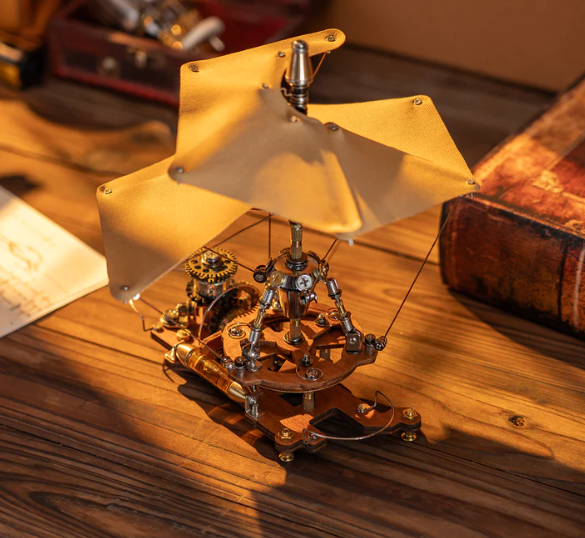
That is what 3d mechanical models do. You build them by hand. When you finish, you have a real object that moves. Gears turn. Wings open. Pistons pump.
That is not common in any hobby. And it is why people keep coming back to these kits.
What Makes These Models Different
Most hobby kits make a still object. You finish it, set it on a shelf, and that is it. The thing just sits there.
Mechanical models are not like that. When you finish one, it still works. You can pick it up and use it.
Turn a crank and the gears spin. Pull a lever and a piston moves. Wind a spring and the wings flap.
These are real systems. They work the same way machines do. You just built them at a small scale, by hand.
That changes the whole build process. You are not just putting parts in order. You are making something that has to work. That keeps your mind fully in it.
Range of 3D Metal Puzzle Kits
3d metal puzzle kits come in many types and skill levels. The range has grown a lot in recent years.
Basic kits have 60 to 100 parts. They take one to two hours to build. They are great for new builders.
Mid-range kits have 150 to 250 parts. They take three to five hours. They have real gear systems or moving arms.
Advanced kits have 300 or more parts. They can take six or more hours. They look like something from a museum when done.
Most regular builders spend their time in the middle range. The builds are fun. They are not too short. They are not too long.
What You Learn While You Build
You begin a build as an enjoyable activity. In the middle you begin to learn things.
You can assemble a gear train to observe that power is transferred from one location to another by gears. While working through a cam system you can observe how spin becomes other forms of motion.
No need to read about it. It’s just a matter of seeing it in your hands.
That’s learning that will stick with them for a while. It will be difficult to forget something you made.
This makes those kits a remarkable suite for engineers and designers. However, they are not limited to tech companies. These buildings are suitable for various curious people.
How to Pick the Right Kit
New buyers often make one of two mistakes. They pick a kit that is too easy. Or they pick one that is too hard.
Here is a simple way to choose:
- First kit ever? Select any object under one hundred and twenty elements. Aim for a build time of 1 to 2 hours. It is more expensive to build right first than hard.
- Done one or two builds? Go for 150 to 250 parts. This is where things get fun.
- Experienced builder? Look for kits with spring systems, multi-stage gears, or moving joints. These will test you.
- Always check the instructions. Good diagrams make a big difference. Bad ones ruin even a good kit.
These Models Last
Metal does not fade. It does not crack. It does not fall apart over time.
A finished metal model looks the same ten years later as it did on the day you built it.
Many builders collect their builds. A shelf of finished models is a real display. Each one took time and care to make. You can see that when you look at them.
Other people comment too. The complete mechanical version often attracts questions. what. How’s it going? Did you make it your own?
The answers are worth giving.
The Bottom Line
These sets require time and awareness. They are not designed for those who need results quickly.
But if you like making things by hand, and you need a hobby with real returns, 3d mechanical fashions are amazing at scale.
You end up with something solid. Something that works. Something you built.
That is hard to beat.