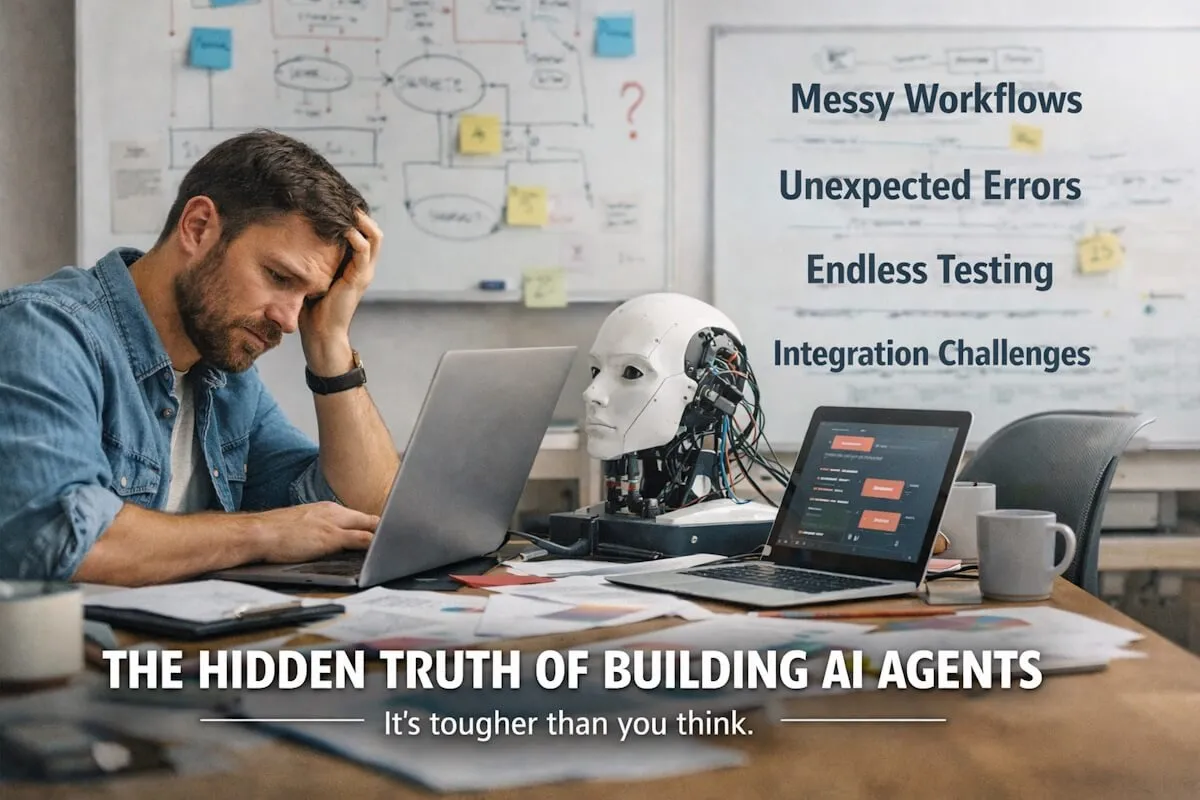
Building AI agents sounds exciting at first.
You set a goal, connect a few tools, and let the system handle tasks on its own. That’s the idea most people have.
And to be fair, that’s part of it.
But once you actually start building, things feel different.
There are a lot of small realities that don’t get talked about enough. These are the things that decide whether your system works in the real world or just looks good in a demo.
Let’s get into what people usually don’t tell you.
It’s less about AI and more about workflows
A lot of people assume the hardest part is the “AI” itself.
It’s not.
The real challenge is understanding your workflows.
If your process is unclear, messy, or full of gaps, your agent will reflect that.
You need to know:
- How work actually gets done
- Where decisions happen
- Where things break or slow down
Without that clarity, even the most advanced system won’t help much.
Your first version will feel underwhelming
This catches people off guard.
You build your first agent and expect something impressive.
Instead, it feels basic.
Maybe it handles one task well. Maybe it still needs supervision.
That’s normal.
Agentic systems improve over time. The first version is just a starting point.
If you expect perfection early, you’ll feel disappointed.
Edge cases will take more time than you expect
In theory, workflows look clean.
In reality, they’re not.
You’ll run into:
- Missing data
- Conflicting inputs
- Unexpected user behavior
- System errors
Handling these edge cases takes time.
And there are always more than you initially think.
Decision design is harder than coding
Writing code is one thing.
Designing how a system decides what to do is another.
You need to define:
- When to act
- What action to take
- When to stop
- When to escalate
This requires careful thinking.
If decision paths are weak, the system becomes unreliable.
You need to limit what the agent can do
It might sound counterintuitive.
But giving your agent too much freedom early on can create problems.
You need boundaries.
Clear rules about:
- What it can do
- What it cannot do
- When human input is required
These limits make the system more predictable and easier to trust.
Integration work is often underestimated
Connecting systems sounds simple.
In practice, it’s one of the more challenging parts.
You’re dealing with:
- Different data formats
- API limitations
- Sync issues between tools
If integrations are weak, execution breaks.
That’s why this part needs careful attention.
Testing takes longer than building
Many teams rush through testing.
They build the system and assume it’s ready.
But real-world testing reveals issues you didn’t expect.
You need to test:
- Different scenarios
- Messy inputs
- Failure conditions
This phase often takes longer than the initial build.
And skipping it leads to problems later.
Your team’s trust matters more than the system itself
Even if your agent works well, it won’t matter if your team doesn’t trust it.
People need to feel confident that:
- The system behaves predictably
- It won’t create extra work
- They can step in when needed
Without trust, adoption slows down.
And the system doesn’t get used properly.
It’s not a “set it and forget it” system
Some expect to build once and move on.
That doesn’t work here.
Agentic systems need:
- Monitoring
- Adjustments
- Improvements over time
You’ll keep refining decision paths and workflows as you learn from real usage.
Small improvements create big impact
You don’t need a perfect system to see results.
Even small changes can make a difference.
For example:
- Faster follow-ups
- Fewer missed tasks
- Better task routing
These improvements add up.
Over time, they significantly change how your business operates.
Why many businesses seek external expertise
Building these systems involves multiple layers.
Workflow design, decision logic, integrations, testing.
That’s why many companies explore Agentic AI Development Services to get structured guidance.
It helps them avoid common pitfalls and move faster.
The value of experienced developers
Not all developers approach this the same way.
When you Hire AI Agent Developers, you’re looking for people who can:
- Design clear workflows
- Handle edge cases
- Build reliable execution paths
This goes beyond just writing code.
It’s about building systems that work in real situations.
The emotional side nobody talks about
This might sound unexpected, but it’s real.
Building AI agents can feel frustrating at times.
You’ll:
- Fix one issue and find another
- Adjust logic multiple times
- Question whether it’s worth it
That’s part of the process.
Once the system starts working consistently, it feels very different.
What success actually looks like
Success is not a flashy system doing everything.
It’s a system that:
- Handles specific tasks reliably
- Reduces manual effort
- Improves consistency
It works quietly in the background.
That’s when you know it’s doing its job.
So, what should you take from this?
Building AI agents is not just about technology.
It’s about:
- Understanding workflows
- Designing decisions
- Managing complexity
- Improving over time
If you go in with the right expectations, the process becomes much smoother.
The real question
You don’t need to build the perfect system right away.
You just need to build something that works and improves over time.
Because once you see it handling real tasks, the value becomes clear.
And from there, everything starts to scale.