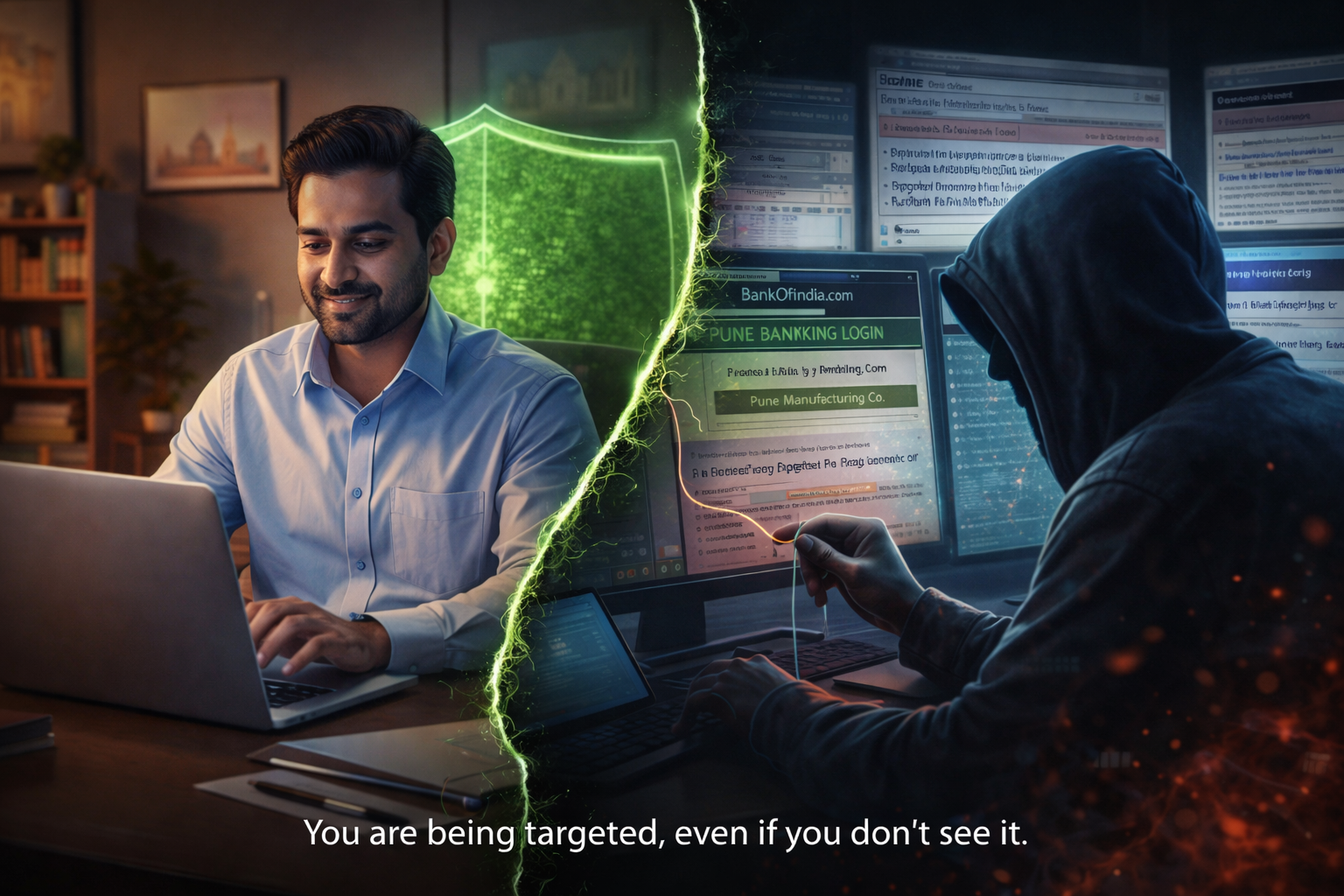
Here is a scenario that plays out every week across Indian businesses. A finance executive at a mid-sized manufacturing company in Pune receives an email from what appears to be the MD’s account. The email asks for an urgent bank transfer to close a vendor deal before end of day. The executive complies. The MD never sent that email. Choosing the best email security software in India that can catch this kind of attack before it reaches your team is no longer optional for businesses that handle financial transactions over email.
This type of attack is called Business Email Compromise, and it cost Indian businesses an estimated Rs. 200 crore last year alone. The attackers were not geniuses. They used publicly available information, a lookalike email address, and the basic human tendency to comply with authority under time pressure.
The uncomfortable truth is that Indian SMBs are disproportionately targeted. Not because they are careless, but because they typically carry valuable financial data and customer records while having significantly less security infrastructure than large enterprises. Cybercriminals know this, and they optimize for it.
If you run or manage a small or mid-sized business in India, this guide is specifically for you. We will walk through the real threat landscape, what actually works in protecting your email, and what to look for when evaluating tools.
Why Email Is Still the Biggest Security Risk for SMBs
Despite the rise of collaboration tools like Slack and Teams, email remains the dominant communication channel for business-critical transactions: invoices, contracts, HR decisions, and financial approvals. This is precisely why it remains the number one attack vector globally.
According to the Verizon Data Breach Investigations Report, over 90% of successful cyberattacks begin with an email. For Indian SMBs specifically, the threat profile looks like this.
- Phishing attacks that mimic trusted brands such as HDFC Bank, the GST portal, and EPFO to steal credentials or install malware.
- Business Email Compromise (BEC) through impersonation of executives or vendors to fraudulently authorize payments.
- Ransomware delivery via malicious attachments or links that encrypt your data and demand payment for recovery.
- Account Takeover (ATO) using stolen credentials to log into employee accounts and operate from within.
The particularly dangerous thing about modern email attacks is that many of them contain no malicious links, no attachments, and no known-bad content. They succeed purely through social engineering, and traditional spam filters are essentially useless against them.
The Compliance Dimension: CERT-In and DPDP Are No Longer Optional
If you are operating a business in India and handling customer data, you now operate in a tightening compliance environment that directly affects your email security decisions.
The CERT-In guidelines, significantly expanded in 2022 and 2023, require organizations to maintain comprehensive logs of IT infrastructure activity, report cybersecurity incidents within a defined timeframe, and implement robust access controls across all digital systems including email.
The Digital Personal Data Protection (DPDP) Act, which came into force in 2023, adds another layer of obligation. If your business stores or processes personal data of Indian citizens, which virtually every business does, you are required to implement reasonable security safeguards to protect it. Email systems are explicitly in scope.
The practical implication is that your email security solution needs to not just protect you from threats, but also generate the audit logs, incident reports, and data residency documentation that regulators can ask for. A basic spam filter does not come close to meeting this bar.
What to Actually Look for When Evaluating Email Security Tools
The email security market is crowded with products making similar claims. Here is a practical breakdown of what actually differentiates tools that protect SMBs from those that just look impressive in a demo.
1. Deployment Speed and Simplicity
If a vendor tells you that deployment will take two to four weeks and involves changing your MX records, that is a red flag for an SMB context. Modern solutions built around API integrations, particularly for Microsoft 365, can be set up in under 10 minutes with no impact on email delivery. Complexity in deployment usually means complexity in ongoing management, which translates to cost and risk for lean IT teams.
2. Detection Methodology
Ask vendors specifically: how does your product detect Business Email Compromise? If the answer involves only keyword matching, sender reputation databases, or attachment scanning, the product will miss the majority of modern BEC attacks. Look for solutions that use behavioral analysis, Natural Language Processing, and relationship mapping between senders and recipients. These are the techniques that actually catch impersonation attacks that contain no traditional threat indicators.
3. India-Specific Context
Global email security vendors are primarily built to detect threats targeting Western enterprises. Indian businesses face a distinct threat landscape with local-language phishing attacks in Hindi, Bengali, and Tamil, spoofing of Indian government portals and banking institutions, and attacker infrastructure hosted within the region. A solution with genuine India-specific threat intelligence will materially outperform a generic global product in your environment.
4. Pricing That Works at SMB Scale
Enterprise email security products are priced for organizations with hundreds or thousands of seats. For a 30-person company, a per-user cost of Rs. 1,500 to 2,000 per month quickly becomes unviable. Look for solutions that offer meaningful protection at a price point that makes sense for Indian SMB budgets, ideally under Rs. 200 per user per month, without requiring you to purchase a large bundle of features you do not need.
5. Compliance Documentation Support
Your chosen solution should make CERT-In and DPDP compliance easier, not harder. This means generating incident reports in formats that regulators recognize, maintaining comprehensive audit logs, and ensuring that all data processing happens within Indian data centers to satisfy data residency requirements.
The Microsoft 365 Reality: Built-In Protection Is Not Enough
A common misconception among Indian SMB owners is that Microsoft 365’s built-in security is sufficient. This is understandable. Microsoft does include a baseline level of email filtering with every M365 subscription. But there are important limitations that every business owner should understand.
Microsoft’s native tools are designed to catch volume threats: mass phishing campaigns, known malware variants, obvious spam. They are explicitly not designed to catch targeted BEC attacks, account takeovers from legitimate IPs, or OAuth-based intrusions. Microsoft’s own documentation acknowledges this and recommends layered third-party protection for organizations that handle sensitive data.
This is why there is a growing category of solutions specifically designed to layer on top of M365, using Microsoft’s own Graph API to access deeper signals and provide the behavioral analysis and threat context that native tools lack.
A Practical Security Checklist for Indian SMBs
Beyond choosing the right software, here is a baseline checklist that every Indian SMB should work through.
- Enable Multi-Factor Authentication on all email accounts. This single step prevents the vast majority of account takeover attacks. There is no valid business reason not to do this today.
- Implement DMARC, DKIM, and SPF for your domain. These email authentication protocols prevent attackers from spoofing your domain, meaning they cannot send emails that appear to come from your company address.
- Conduct a phishing simulation with your team. Human behavior is always the final security layer. A basic simulation exercise will show you how your team responds and give you a benchmark for improvement.
- Audit third-party app permissions. Review which applications have access to your email environment. Revoke any that are not actively used or that have more permissions than necessary.
- Deploy a dedicated email security layer. A purpose-built solution that provides behavioral analysis and BEC detection is now essential for any business handling financial transactions or customer data.
- Create and test an incident response playbook. Know in advance: if you receive a suspicious email or a colleague’s account is compromised, what are the exact steps your team takes? Having this documented before a crisis makes the response faster and more effective.
What AI Is Changing About Email Security for SMBs
The most significant development in the email security space over the past two years is the practical application of AI, specifically Large Language Models (LLMs) and Natural Language Processing (NLP), to threat detection.
Traditional email security worked by matching patterns: known malicious URLs, known malware signatures, known spam phrases. This approach is fundamentally reactive and can only catch threats that have been seen before. AI-based detection is different. By analyzing the semantic content, behavioral context, and relationship patterns of emails, it can identify threats that have never been seen before, including first-use phishing domains, novel BEC scripts, and unusual account behavior that precedes an attack.
For Indian SMBs, this matters because it fundamentally changes the economics of protection. The category of AI email security software for SMBs is democratizing access to detection capabilities that previously required a dedicated security operations center. A 25-person company can now have behavioral threat detection that would have been unaffordable outside a large enterprise five years ago.
The key is choosing a solution that is not just labeling itself as AI-powered as a marketing term, but one where AI is genuinely embedded in the detection methodology. The system should learn your communication patterns, flag anomalies, and improve over time.
Final Thoughts: Security Is a Business Decision, Not Just an IT Decision
The business owners and finance leaders reading this article are the actual decision-makers when it comes to cybersecurity investment. IT teams can recommend, but ultimately it is a business that absorbs the financial and reputational cost of a breach, not the software vendor and not the IT manager who raised concerns that were deprioritized.
The cost of a single successful BEC attack, even a modest one, typically exceeds the annual cost of a comprehensive email security solution by an order of magnitude. The question is not whether you can afford to invest in protection. The question is whether you can afford not to.
India’s digital economy is growing fast. The threat actors targeting Indian businesses are growing faster. The good news is that the tools to protect yourself have never been more accessible, more capable, or more affordable for businesses at the SMB scale.