

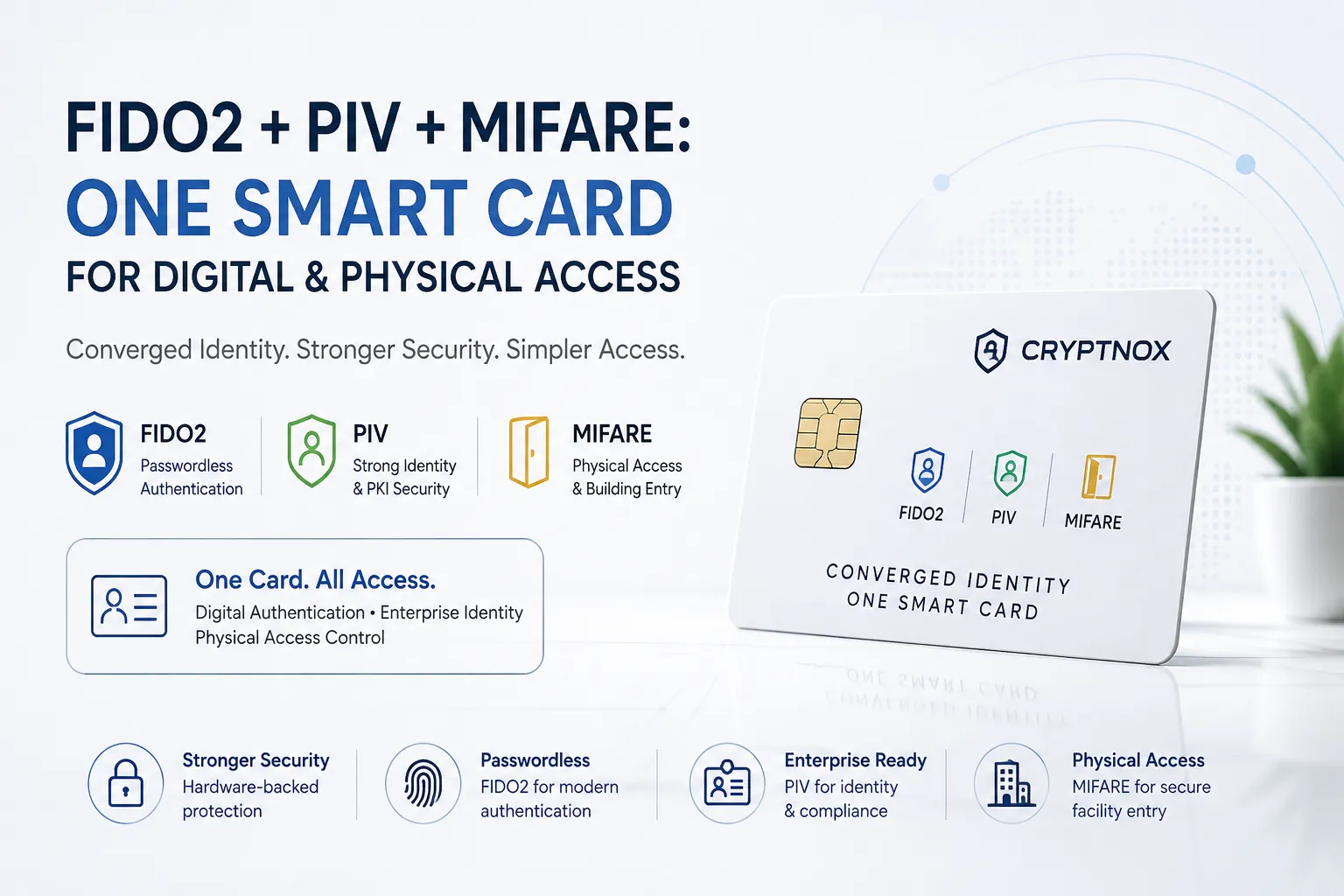
Modern enterprises need secure ways to verify users, protect corporate systems, and control access to physical facilities. Traditionally, these requirements have been handled through separate credentials: one for computer login, another for identity verification, and another for entering an office or restricted area. This fragmented approach can increase administrative complexity and create more credentials for employees to manage.
Combining FIDO2 and PIV authentication with MIFARE-based physical access capabilities offers a different model. A single smart card can support modern passwordless authentication, certificate-based enterprise identity, and physical access functions within a converged credential architecture.
This approach can simplify the employee experience while helping organizations build a more consistent identity and access strategy.
What Is Converged Identity?
Converged identity refers to bringing multiple identity and access functions into a single credential or coordinated security architecture.
Instead of maintaining separate cards for logical access and physical access, an organization can use a credential capable of supporting different authentication technologies.
A modern converged identity smart card may combine:
-
FIDO2 authentication for passwordless access
-
PIV credentials for enterprise identity and certificate-based authentication
-
MIFARE technology for compatible physical-access systems
-
Hardware-backed credential storage
-
Support for logical and physical access workflows
The objective is not simply to put several technologies on one card. The broader goal is to create a credential that can support different security requirements while giving employees a simpler authentication experience.
How FIDO2 and PIV Authentication Work Together
FIDO2 and PIV authentication address different aspects of enterprise identity security.
FIDO2 is widely associated with passwordless authentication. It uses public-key cryptography to authenticate users without requiring traditional passwords for supported services.
PIV, or Personal Identity Verification, is designed around strong identity credentials and certificate-based authentication. PIV smart cards can be used for applications such as enterprise login, certificate authentication, digital signatures, and other identity workflows.
When these technologies are combined, organizations can support both modern passwordless authentication and established certificate-based identity requirements.
For example, an employee could use FIDO2 authentication to access a compatible cloud application while using PIV credentials for an enterprise workstation or certificate-based service.
This makes FIDO2 and PIV authentication complementary rather than competing approaches.
What Does MIFARE Add to the Smart Card?
FIDO2 and PIV primarily address digital identity and authentication. MIFARE, by contrast, is commonly associated with contactless applications and physical-access environments.
When incorporated into an enterprise credential, MIFARE can support compatible access-control systems used for doors, facilities, or other physical environments.
This creates the possibility of a logical and physical access card that can serve multiple functions.
For instance, an employee entering an office could use the same physical credential for building access and later use it for secure authentication to corporate systems, depending on the organization’s infrastructure.
The technologies remain functionally distinct, but they can coexist within a single employee credential.
Benefits of a FIDO2 PIV MIFARE Smart Card
A FIDO2 PIV MIFARE smart card can provide several advantages for organizations managing enterprise identity.
One Credential for Multiple Access Requirements
Employees may no longer need to carry separate credentials for every access scenario. A single card can support digital authentication and compatible physical-access functions.
This can simplify daily workflows and reduce credential-management complexity.
Stronger Hardware-Based Security
Smart cards can provide hardware-backed protection for sensitive credentials and cryptographic operations. Instead of relying entirely on software-based credentials, organizations can use dedicated hardware to help protect identity information.
This is particularly relevant for enterprises managing privileged users, sensitive systems, regulated information, or restricted facilities.
Passwordless Authentication
FIDO2 enables supported applications and services to move toward passwordless authentication. Removing passwords from the authentication process can reduce exposure to password reuse, phishing, and credential theft.
The exact security benefits depend on proper deployment, enrollment, device management, and application support.
Converged Physical and Digital Access
A major advantage of a combined credential is the ability to connect digital identity with physical access.
An authentication and access-control card can potentially support both computer authentication and building access, reducing the number of physical credentials employees need to manage.
Practical Enterprise Example
Consider a company with several hundred employees working across a corporate office.
Previously, an employee might receive:
-
An employee access badge for entering the building
-
A smart card for certificate-based computer authentication
-
A separate security key for passwordless cloud authentication
Managing three credentials creates additional operational overhead.
With a converged credential architecture, the organization could deploy a converged employee credential supporting compatible FIDO2, PIV, and MIFARE functions.
The employee could use the card for building access, certificate-based authentication, and supported passwordless services. IT teams would still need to configure each environment correctly, but the employee experience becomes considerably more streamlined.
FIDO2, PIV and MIFARE: Are They the Same Technology?
No. FIDO2, PIV, and MIFARE serve different technical purposes.
FIDO2 focuses on modern authentication and passwordless access.
PIV focuses on identity credentials, certificates, and strong enterprise authentication.
MIFARE is associated with contactless applications, including compatible physical-access systems.
The value of combining them comes from their complementary roles. A converged identity smart card can provide a common physical credential while allowing each technology to perform its intended function.
Organizations should therefore evaluate compatibility with their existing identity providers, operating systems, access-control infrastructure, certificate authorities, and applications before selecting a combined smart-card solution.
Is a Combined Smart Card Right for Every Enterprise?
Not necessarily. A converged credential is most valuable when an organization has multiple identity and access requirements that can benefit from consolidation.
Before deployment, security teams should assess:
-
Existing PIV and PKI infrastructure
-
FIDO2 application and identity-provider support
-
Physical-access system compatibility
-
Credential issuance and lifecycle management
-
Certificate provisioning and renewal
-
Lost or stolen card procedures
-
Employee enrollment and recovery processes
-
Compliance and security requirements
A successful deployment depends as much on the surrounding identity architecture as on the smart card itself.
For organizations looking to consolidate authentication and access functions, a FIDO2 and PIV authentication solution can provide a foundation for a multi-purpose enterprise credential.
The Future of Enterprise Identity Credentials
As organizations move toward passwordless authentication and stronger identity security, the distinction between digital and physical credentials is becoming increasingly important.
A FIDO2 PIV MIFARE smart card represents a converged approach in which authentication, identity verification, and compatible physical access can coexist within one credential.
For enterprises, the value is not simply convenience. A properly designed logical and physical access card can help create a more unified identity strategy while reducing credential fragmentation.
Conclusion
Combining FIDO2, PIV, and MIFARE on one smart card provides a practical approach to converged identity. FIDO2 supports modern passwordless authentication, PIV provides strong certificate-based enterprise identity, and MIFARE can support compatible physical-access environments.
Together, these technologies can transform a traditional employee badge into a multi-purpose enterprise credential capable of supporting both digital and physical access requirements.
For organizations considering this approach, the key is to evaluate the entire identity ecosystem rather than the card alone. Compatibility, credential lifecycle management, PKI infrastructure, authentication policies, and physical-access systems all play an important role. When properly implemented, a converged employee credential can simplify access workflows while supporting stronger, more flexible enterprise identity security.
